How IT Support Service Providers Minimise Business IT Risks
Every business depends on technology, whether it is managing customer information, processing payments, collaborating with remote teams, or communicating with suppliers. While technology creates new opportunities, it also introduces risks that can interrupt operations, expose sensitive data, or increase costs. Working with an experienced IT support services provider in London can help businesses identify and reduce these risks before they lead to serious disruption, whether the issue involves hardware failures, cyber attacks, software vulnerabilities, or human error.
That is why many businesses partner with experienced providers such asSereno IT Suppor. Rather than simply fixing technical problems after they occur, professional IT service providers help businesses identify, manage, and reduce risks before they become major issues.
This article explores the role IT service providers play in mitigating IT risks, the strategies they use to protect organisations, and why proactive IT management is essential for long-term business success.
Understanding IT Risks
IT risk refers to any event that could negatively affect a business’s technology, data, or operations. Some risks develop suddenly, while others build gradually over time.
Common IT risks include
- Cybersecurity attacks
- Hardware failures
- Software vulnerabilities
- Data loss
- Human error
- Network outages
- Cloud service interruptions
Without proper planning, these risks can result in financial losses, downtime, damaged reputations, and reduced customer confidence.
Why IT Risk Management Matters
Many organisations think about IT only when something stops working. Unfortunately, reacting after a problem occurs is usually more expensive than preventing it in the first place.
Effective IT risk management helps businesses:
- Reduce downtime
- Protect customer data
- Improve operational reliability
- Meet compliance requirements
- Maintain business continuity
Instead of constantly solving emergencies, businesses can focus on growth and innovation.
How IT Service Providers Identify Risks
Professional IT providers begin by understanding the organisation’s current technology environment.
Infrastructure assessments
Systems, servers, workstations, cloud services, and networks are reviewed to identify weaknesses.
Security assessments
IT specialists evaluate firewalls, user permissions, software versions, and security configurations.
Risk prioritisation
Not every risk has the same impact. Providers help businesses prioritise the most critical vulnerabilities first.
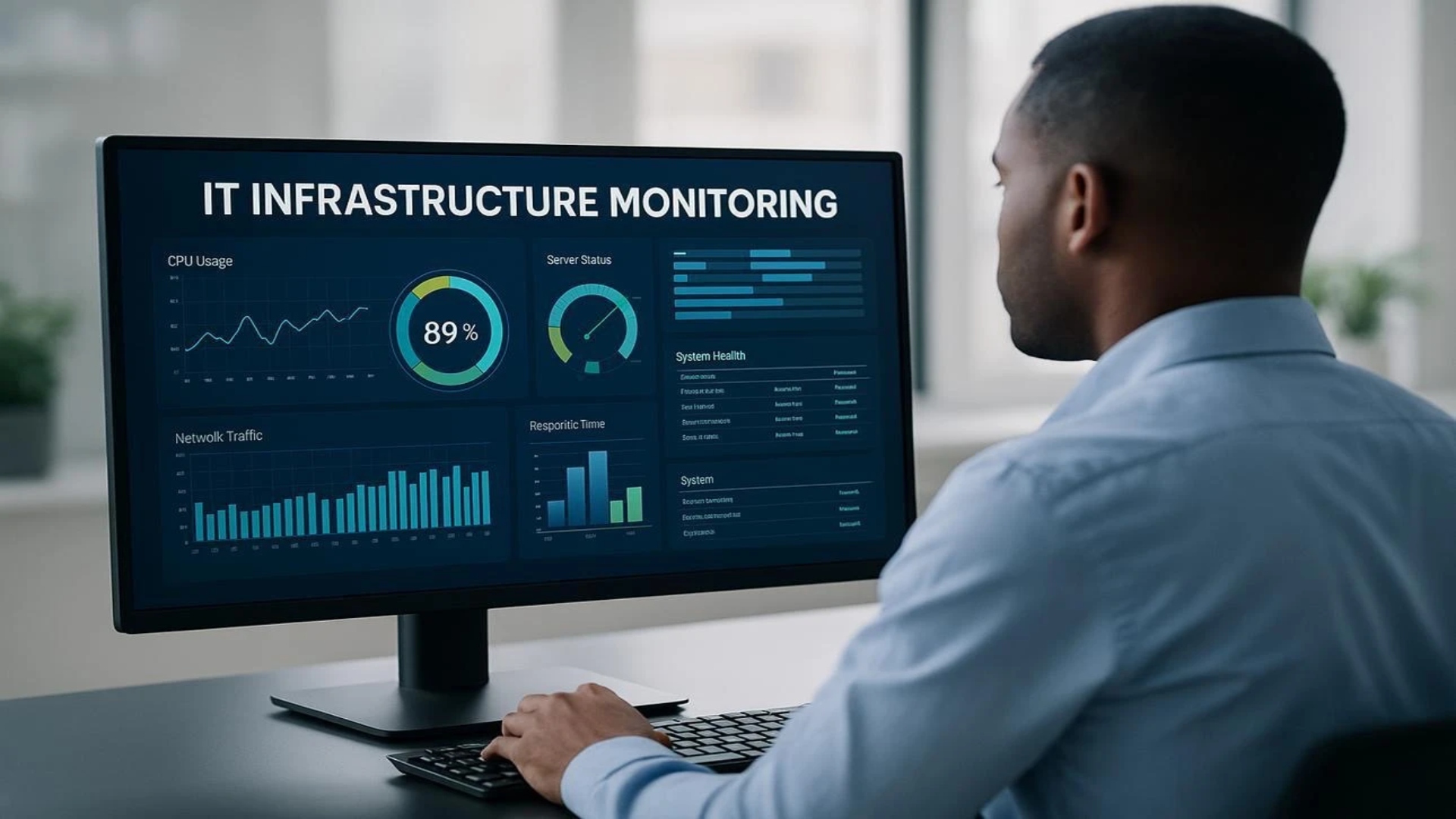
Proactive Monitoring Prevents Problems
One of the biggest advantages of managed IT services is continuous monitoring.
Monitoring can identify
- Unusual network activity
- Hardware performance issues
- Storage capacity problems
- Software failures
- Security threats
Early detection often prevents costly business interruptions.
Strengthening Cybersecurity
Cybersecurity remains one of the largest IT risks facing businesses today. The UK National Cyber Security Centre’s Small Business Guide provides practical advice on reducing common cyber risks, including phishing attacks, malware, and password security
Professional IT service providers implement multiple layers of protection rather than relying on a single security solution.
Security measures include
- Endpoint protection
- Firewalls
- Email filtering
- Multi-factor authentication
- Security patch management
- Threat detection
- Security awareness training
Together, these controls significantly reduce the likelihood of successful cyber attacks.
Protecting Business Data
Data is often one of a company’s most valuable assets.
Losing customer records, financial documents, or operational information can seriously affect the business.
IT providers help by implementing
- Automated backups
- Secure cloud storage
- Disaster recovery planning
- Backup testing
- Recovery procedures
Regular testing is just as important as creating backups. A backup that cannot be restored provides little protection.
Supporting Business Continuity
Unexpected events happen.
Power outages, ransomware attacks, hardware failures, and natural disasters can all interrupt operations.
Professional IT providers help businesses prepare by developing business continuity plans.
These plans include:
- Recovery priorities
- Alternative working methods
- Communication procedures
- Recovery time objectives
- Infrastructure redundancy
Businesses recover much faster when a tested continuity plan already exists.
Managing Software and Hardware Lifecycles
Outdated technology often creates hidden risks.
Older hardware becomes unreliable, while unsupported software may contain security vulnerabilities.
IT providers help organisations by:
- Tracking equipment age
- Scheduling upgrades
- Managing software licences
- Applying updates
- Replacing unsupported systems
Lifecycle management reduces long-term costs while improving reliability.
Supporting Regulatory Compliance
Many industries operate under strict regulatory requirements.
IT service providers help organisations meet compliance obligations through:
- Secure data management
- Access controls
- Audit logging
- Encryption
- Documentation
- Security policies
Compliance reduces legal risks while improving customer confidence.
Helping Employees Reduce Human Error
Technology alone cannot eliminate IT risks.
People remain one of the biggest sources of security incidents.
IT providers often support businesses by delivering:
- Cybersecurity awareness training
- Password best practices
- Phishing simulations
- Device security guidance
Educated employees become an additional layer of protection rather than a vulnerability.
Improving Vendor Management
Many businesses rely on multiple software vendors, cloud platforms, internet providers, and hardware suppliers.
Managing these relationships can become time-consuming.
IT providers simplify this process by:
- Coordinating with vendors
- Managing software licences
- Escalating technical issues
- Tracking renewals
- Evaluating new technologies
This reduces administrative workload for internal teams.
Common IT Risks and How Providers Reduce Them
| IT Risk | How IT Service Providers Help |
| Cyber attacks | Continuous monitoring, endpoint protection, email security |
| Data loss | Automated backups and disaster recovery |
| Downtime | Proactive monitoring and maintenance |
| Human error | Employee security awareness training |
| Compliance issues | Security controls and documentation |
| Outdated systems | Lifecycle management and planned upgrades |
Building a Long-Term Technology Strategy
Reducing IT risks is not only about solving today’s problems.
Professional IT providers help businesses create long-term technology strategies that support future growth.
These strategies often include:
- Infrastructure planning
- Cloud adoption
- Security improvements
- Budget forecasting
- Digital transformation initiatives
Rather than making reactive technology decisions, businesses can invest strategically.
Why Small Businesses Benefit the Most
Large organisations often have dedicated internal IT departments.
Small businesses usually have fewer technical resources available, making external expertise particularly valuable.
Working with an IT service provider gives SMEs access to:
- Enterprise-level expertise
- Predictable monthly costs
- Broader technical knowledge
- Faster issue resolution
- Scalable support
This allows business owners to concentrate on customers and growth instead of technical emergencies.
Frequently Asked Questions
What is IT risk management?
IT risk management is the process of identifying, assessing, and reducing technology-related risks that could affect business operations.
Why should businesses use an IT service provider?
Professional providers bring expertise, proactive monitoring, cybersecurity protection, and strategic planning that many businesses cannot maintain internally.
Can IT service providers prevent every cyber attack?
No system can eliminate every risk completely. However, professional IT management significantly reduces the likelihood and impact of cyber incidents.
Is IT risk management only important for large businesses?
No. Small businesses are often targeted because they may have fewer security measures in place, making proactive risk management even more valuable.
Conclusion
Technology risks are an unavoidable part of modern business, but they do not have to become business disasters. From cybersecurity threats and hardware failures to compliance challenges and human error, organisations face a wide range of risks every day.
Professional IT service providers play a vital role in reducing those risks through proactive monitoring, preventative maintenance, strategic planning, cybersecurity management, and business continuity support. Rather than simply fixing problems, they help businesses build stronger, more resilient technology environments.
By investing in proactive IT services and partnering with experienced professionals, organisations can improve security, reduce downtime, protect valuable data, and create a stable foundation for future growth. In today’s digital economy, managing IT risks is no longer optional – it is an essential part of running a successful business.

Stay updated with our latest publications.
Discover Issues
See how we can help you grow in the online space!
Advertise With Us
We can help promote your business.
Find Out More