
Why Growing Agencies Outgrow Task Trackers: Connecting Delivery, Schedules and Capacity
Winning more clients is usually treated as proof that an agency is growing in the right direction. Operationally, however, growth introduces a different challenge. More accounts mean more deadlines moving at once, more specialists shared between projects and less room for inaccurate estimates. A setup that worked when ten jobs could be coordinated through meetings, spreadsheets and task boards can become fragile when the same team is responsible for thirty.
The problem is not simply having more work. It is keeping delivery, schedules and capacity connected. Agencies need to know what has been promised, when it can realistically be delivered and whether the people required to do the work are actually available. When those answers live in separate systems, a business can look fully occupied while having surprisingly little visibility into how much additional work it can absorb profitably.
Growth exposes the limits of task-by-task planning
Agency workload rarely arrives in predictable blocks. A website project may suddenly need additional development time, a campaign can acquire another approval round and a retainer client may request urgent work at exactly the moment two launches require the same creative team. The challenge is therefore not only the total number of employees, but which skills are needed, on which projects and at what time.
This is where simple task tracking begins to lose context. A deadline may look realistic until another project moves and takes the same specialist with it. Additional scope is not merely another task on a board; it consumes capacity that may already have been promised elsewhere. As these dependencies multiply, project delivery and resource planning can no longer be treated as separate administrative activities.
A deadline is only credible when capacity supports it
Agencies often begin scheduling from the client deadline and work backwards. That may be enough for straightforward assignments, but complex delivery requires more. The plan needs to show what must happen first, which activities depend on others, who owns them and what will happen elsewhere if a key task moves. The practical question changes from “Can we fit these tasks before the deadline?” to “Do we have the right people available when each dependency requires them?” Three available designers do not solve a bottleneck if the project actually needs a senior developer and the same strategist who is already committed to two other accounts.
This is why integrated project management software becomes more valuable as an agency scales. Bringing schedules, workloads, budgets, risks and delivery information into one environment makes it easier to understand the consequences of a change before it reaches the client. The objective is not more administration, but a clearer relationship between what has been promised and what the organisation can realistically deliver.
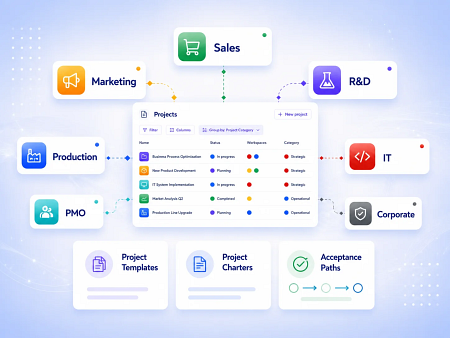
A shared project environment helps growing organisations connect delivery decisions with schedules, teams and wider business priorities.
Capacity planning is also margin protection
Agency leaders understandably monitor utilisation because people are usually one of the largest operating costs. But maximum utilisation is not the same as healthy capacity. Teams also need time for reviews, internal communication, pitches, unexpected revisions and the normal interruptions that accompany client work.
The more useful question is whether the agency can match available expertise with upcoming demand without creating hidden overload. If two launches need the same senior specialist during the same week, management should see the conflict while there is still time to rebalance the work. If a deadline moves, planners should understand where capacity will be released or where pressure will increase.
This matters particularly for fixed-fee work. An agency can protect a promised delivery date by adding more senior people or extra hours, but the project may become less profitable in the process. Good operational visibility does not remove that trade-off; it makes it visible early enough for management to choose consciously.
Scaling requires one operating picture
As an agency grows, fragmentation creates its own cost. Project managers work from delivery plans, leadership looks at commercial forecasts, teams communicate in chat and resource availability may still be maintained elsewhere. Every tool can contain correct information while nobody has a complete picture of the engagement. A shared environment reduces the amount of time spent reconstructing context. It also becomes more important for international and distributed teams, where informal knowledge does not travel as easily between offices and time zones. FlexiProject, for example, supports an interface in 28 languages and provides mobile access for reviewing assigned tasks, changing status and adding comments or attachments, helping teams keep delivery information current when work happens away from a desk.
The purpose is not to force every client project into an identical workflow. A long implementation may need milestones and dependencies, while an ongoing creative engagement may work better with a visual board. What needs to remain consistent is the management picture: what is being delivered, when it is due, who is needed and whether the agency still has room to make another commitment.
Predictability is the real test of agency growth
Growing agencies do not need additional process simply because they are larger. They need enough structure to stop complexity from turning into avoidable surprises. When scheduling, capacity and delivery are managed separately, each view can appear reasonable while the organisation as a whole becomes overloaded. Connecting them changes the quality of decisions. A deadline is considered together with the people needed to achieve it, resource changes are evaluated against scheduled work and commercial commitments can be made with a clearer understanding of delivery reality.
The agencies that scale well are rarely the ones that keep everybody busiest. They are the ones that understand what their teams can realistically deliver, protect the capacity required to do good work and recognise pressure before the client does.

Stay updated with our latest publications.
Discover Issues
See how we can help you grow in the online space!
Advertise With Us
We can help promote your business.
Find Out More