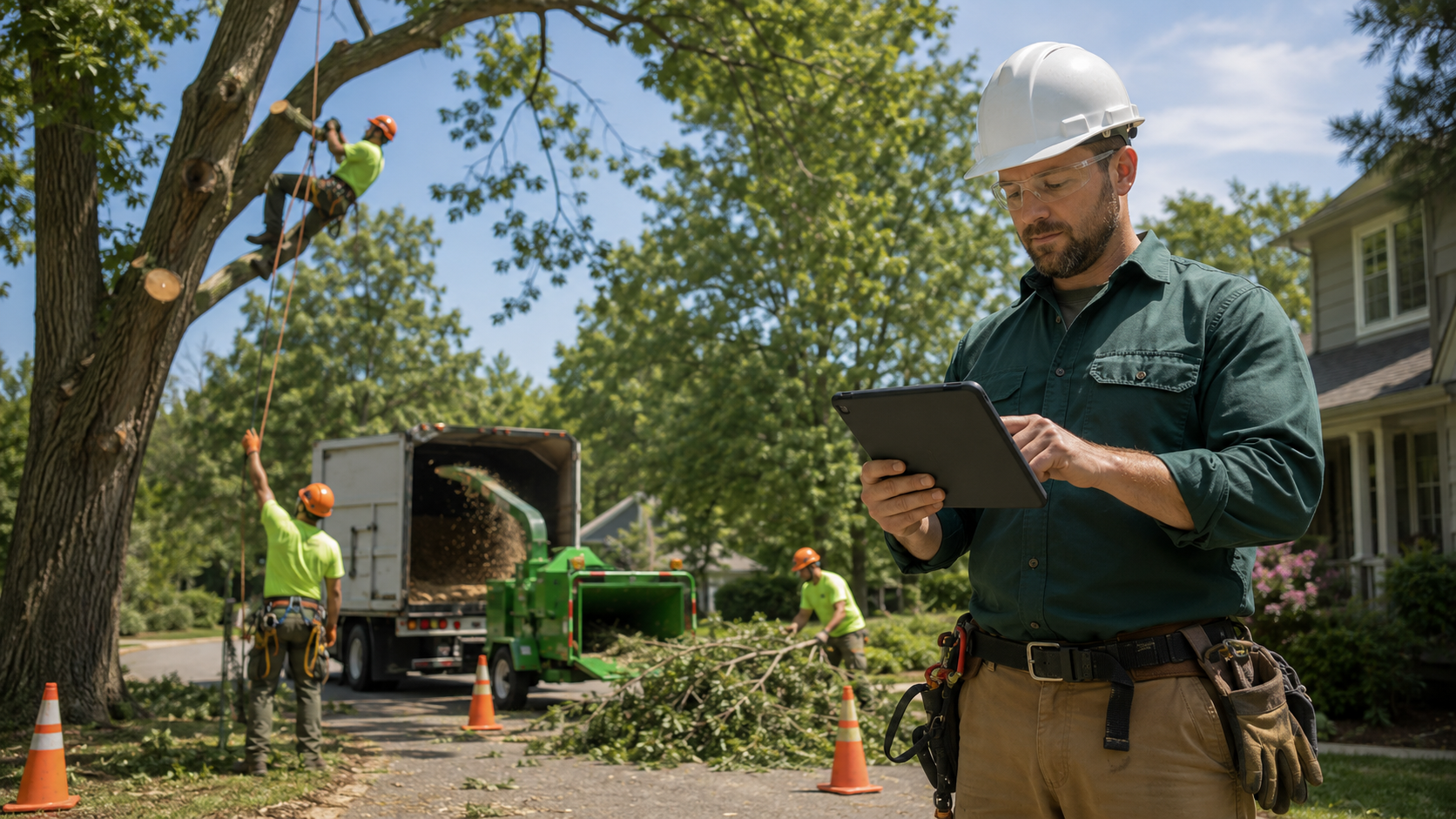
From Full-Service Tree Care Crews to Cash Flow: How Software Helps Tree Service CEOs Scale Operations
Tree service CEOs scale by unifying estimates, schedules, crew instructions, records, invoices, and payments in one system, giving visibility into crew capacity, profitability, and revenue, and enabling growth without proportional admin work. A five-person shop runs on the owner’s memory; at 20-30 employees, memory stops being a management system.
Full-service tree care crews need one operating record
Full-service tree care spans pruning, removals, plant health care, cabling, transplanting, fertilization, consulting, and storm response – work OSHA recognizes industry-wide, each task with its own requirements. Tofu ties customer records, estimates, schedules, job details, invoices, and payments into one continuous thread. When an arborist examines a failing oak, size, access limits, equipment, and disposal volume must reach the scheduler, crew, billing team, and customer – along with photos, notes, approved scope, and payment status. Skip that link, and handoffs falter: wrong trucks arrive, work goes unbilled, estimates vanish with departing staff.
How software turns fieldwork into cash flow
Revenue does not enter the bank when a crew finishes cutting. It enters after the work is documented, billed, delivered to the customer, and paid.
That difference matters because a business can have a full calendar and still face a cash shortage. Payroll, fuel, dump fees, repairs, insurance, and equipment payments continue while completed work waits to be invoiced.
A connected workflow reduces billing delay in three ways:
- The approved estimate becomes the billing record. Office staff do not need to rebuild line items from handwritten notes.
- The crew confirms completion from the job site. Photographs, additional work, disposal charges, and customer approvals are attached before anyone leaves.
- The invoice reaches the customer immediately. Digital delivery and payment options reduce the distance between completion and collection.
Suppose a crew completes a removal at 3:30 p.m. In a disconnected process, the crew leader sends a text to the office. The office creates the invoice two days later, discovers a missing disposal charge, and waits for clarification. The customer receives the bill four days after the job.
In a connected process, the crew confirms the final scope, adds the disposal charge, uploads photographs, and marks the job complete. The invoice can be sent before the crew returns to the yard.
What tree service CEOs should measure before scaling operations
Adding crews before measuring the current operation can multiply existing problems. CEOs should first establish a baseline for sales, scheduling, production, billing, and collection.
A useful dashboard does not need dozens of indicators. Start with measures that reveal where work slows down or loses margin.
| Operating measure | What it reveals | Review frequency |
| Estimate response time | How quickly prospects receive a price | Weekly |
| Estimate acceptance rate | Whether pricing and scope fit the market | Weekly |
| Revenue per crew day | Production value of scheduled capacity | Daily and weekly |
| Planned versus actual labor hours | Accuracy of estimates and crew execution | Per job |
| Completion-to-invoice time | Speed of administrative handoff | Daily |
| Days to payment | Collection performance | Weekly |
These measures should be segmented by service type. A company-wide average can hide underperforming service lines.
For example, pruning may deliver a lower invoice but stronger revenue per crew hour because setup and disposal are limited. Large removals may produce more revenue while using cranes, climbers, traffic control, and disposal capacity. Plant health care may offer repeat revenue with lighter equipment requirements.
The goal is to compare jobs with similar operating profiles, rather than treating every dollar of revenue as equal.
How tree care software improves scheduling without overloading crews
Tree care software helps schedulers match each job with qualified crews, available equipment, travel time, site instructions, disposal needs, and weather risks. Unlike a basic calendar, it shows whether the day’s plan is practical. It also helps owners protect capacity for breakdowns, emergencies, delays, and overruns. Many companies reserve 10% to 20% of expected capacity, then adjust this buffer using operating data.
Safety data belongs in the operational workflow
Safety records should not sit in a separate binder that crews rarely see. Site hazards, equipment requirements, crew qualifications, and emergency instructions belong in the job record.
The OSHA Tree Care Industry guidance describes overhead power lines, falling branches, and faulty safety equipment as potentially fatal hazards. OSHA also links to fatality investigations involving wood chippers, stump grinders, falls, electrocution, and falling limbs.
Software cannot make field decisions for a qualified arborist or replace required training. It can support consistent preparation by ensuring that job information reaches the people performing the work.
A digital job packet may include:
- Site photographs and marked work zones.
- Overhead and underground utility notes.
- Traffic and pedestrian ex
- posure.
- Tree condition and visible defects.
- Required personal protective equipment.
- Climbing, rigging, lift, or line-clearance requirements.
- Crew qualifications.
- Equipment inspection confirmations.
- Emergency address and access information.
- Customer-approved scope and exclusions.
A crew leader should still conduct an on-site assessment because conditions can change after the estimate. The digital record provides a starting point and documents what the company knew before dispatch.
Choosing tree service management software for the next stage
Choose software based on company size, services, and operating maturity. Test workflows, not feature counts: estimate creation, site notes, crew and equipment assignment, scope changes, offline completion, invoicing, payment tracking, and service history. Field teams should test usability with gloves, sunlight, and weak signals. Prioritize mobile access, offline sync, CRM, scheduling, approvals, photos, permissions, exports, accounting integrations, and vendor support.
From full-service tree care crews to scalable operations
In addition to crews and equipment, growth in tree care is measured in the number of estimates, schedules, job details, invoices, and follow-ups to be tracked. Right software connects the dots, cuts down on duplicate data entry, and ensures teams in the field and in the office are connected. Instead of automating all at once, it’s better to develop one consistent process that’s going to run reliably from estimate to final payment. Then, when it functions properly, new crews can grow at a steady rate, maintaining margins and growing cash flow.

Stay updated with our latest publications.
Discover Issues
See how we can help you grow in the online space!
Advertise With Us
We can help promote your business.
Find Out More