CRM Data Quality: The Fastest Way to Improve Conversion Rates
If conversion rates are soft, most teams reach for the usual levers: new messaging, new sequences, new ads, more SDR activity. Those can help, but there’s often a faster lever that improves almost every growth motion at once: CRM data quality.
This guide shows how to improve CRM data quality to increase lead-to-meeting conversion and pipeline efficiency.
When your CRM has stale contacts, duplicates, and inconsistent fields, you end up with the same painful symptoms across the funnel:
- Low email reply rates because you’re targeting the wrong people or messaging with the wrong context
- Wasted spend because lists and audiences are polluted
- Uneven lead routing because territories and fit signals are missing
- Forecasting that looks “off” because pipeline stages and ownership histories are fragmented
This post breaks down the highest impact fixes CEOs and RevOps leaders can implement quickly, plus the KPIs that prove improvement in revenue terms.
Why CRM Data Quality Impacts Conversion Rates More Than Most Teams Realise
Your CRM is not just a system of record. It powers how revenue happens.
Every meaningful growth motion depends on accurate records:
- Segmentation: who you target, who you exclude, and how you personalise
- Routing: who gets the lead, how fast they receive it, and whether it’s the right rep
- Personalisation: role, industry, location, company size, tech stack, and intent context
- Attribution: what drove engagement, meetings, and pipeline so you can double down
When data quality slips, it creates a chain reaction:
Bad records → wrong targeting → poor engagement → fewer meetings → weaker pipeline → lower revenue per dollar spent.
That’s why data quality often beats “better copy” as a conversion lever. The copy can be great, but if the record is wrong, you’re still pushing the wrong message to the wrong person.
The 3 CRM Data Problems That Quietly Kill Revenue
1) Data decay (the silent conversion killer)
People change roles. Companies reorganise. Email addresses change. Phone numbers go dead. Even when your offer is strong, stale contact data ensures your outreach never reaches the decision maker.
What this looks like in the business:
- Higher bounce rates and lower deliverability
- More “not the right person” replies
- Lower call connect rates
- SDRs spending time researching basics that should already exist
2) Duplicate records (split history, split ownership, split outcomes)
Duplicates are more than a cleanliness issue. They create operational failure:
- Split activity history means reps miss context
- Misrouted leads bounce between owners
- Double outreach irritates prospects
- Reporting becomes unreliable because pipeline is counted twice or fragmented
In CEO terms: duplicates increase CAC and reduce win rate, even if your team “works hard.”
3) Misaligned fields (collecting “nice-to-have” instead of “conversion-critical”)
Many CRMs capture lots of data that doesn’t actually improve conversion. Meanwhile, the fields that do matter for targeting and routing are missing or inconsistent.
Conversion-critical fields typically include:
- Role or job function (in a consistent taxonomy)
- Region and territory signals
- Company size or segment definition
- Lifecycle stage definitions that mean the same thing across teams
- Next step and close date discipline once pipeline exists
If those fields are inconsistent, your segmentation and routing degrade, and conversion drops in ways that are hard to diagnose.
CRM Data Hygiene Checklist That Improves Conversion Rates Fast
These are practical fixes that can be implemented without turning data hygiene into a bureaucracy project.
Set required field standards by lifecycle stage
Instead of making everything required for everyone, define what must be present at each stage.
Example approach:
- Lead: email, company, source, country/state, role category
- MQL: job function, company size band, ICP fit indicator, routing territory
- SQL: validated phone, seniority level, buying role, meeting outcome fields
- Opportunity: close date, amount, primary use case, competitors, next step
This keeps the CRM usable while ensuring data becomes more complete as the record becomes more valuable.
Use CRM validation rules where it matters
Validation rules prevent garbage from entering the system.
High-impact validations:
- Email format and blocked personal domains when appropriate
- Phone format normalisation by region
- State/country standardisation and picklists
- Job function taxonomy (avoid free-text chaos)
- Required “next step” for opportunities to prevent dead pipeline
The goal is not perfection. The goal is consistent inputs for segmentation, routing, and reporting.
Create dedupe and merge rules with ownership logic
Dedup needs two things: clear match logic and clear ownership outcomes.
Practical rules:
- Match on email plus company domain
- Use fuzzy matching for company names, but require confirmation for merges
- Decide what happens when duplicates have different owners
- Define which record becomes the “master” based on recency, completeness, or lifecycle stage
If you do not define ownership outcomes, dedupe turns into internal conflict, and it will stop.
Tie lead routing to fit, territory, and speed-to-lead
Routing is a conversion lever. A clean CRM makes routing accurate and fast.
Routing should consider:
- ICP fit or segment
- Geography or territory rules
- Inbound speed (first touch SLA)
- Account ownership, so leads do not get stranded
Clean routing reduces lead leakage and increases lead-to-meeting conversion.
Add enrichment and a refresh cadence
Even clean data decays. You need a plan to refresh it.
A simple cadence:
- Refresh high-value contacts and accounts monthly or quarterly
- Refresh unworked leads less frequently
- Enrich only the fields that affect conversion, routing, or qualification
- Track overwrite rules so enrichment doesn’t destroy better human-entered data
Enrichment is most valuable when it updates fields that change outreach relevance and routing accuracy.
When Regulated Industries Require Eligibility, Data Quality Becomes a Conversion Lever
In many industries, “good contact info” is only half the battle. You also need eligibility—proof someone is allowed to sell, advise, operate, or transact. That’s common in regulated categories like insurance, certain areas of financial services, healthcare-adjacent markets, and other license-driven professions.
Insurance is a perfect example because targeting isn’t just about reaching the right title. It’s about reaching someone who is actually licensed and active, and ideally licensed in the right state(s). If your CRM doesn’t store that cleanly (or stores it inconsistently), you get predictable conversion killers:
- Outreach goes to people who can’t legally do what you need
- Segmentation gets sloppy (wrong states, wrong license status)
- Routing breaks (leads go to the wrong territory/rep)
- Performance reporting becomes noisy because “bad fit” leads inflate your funnel
The fix is the same principle as the rest of this post: use verified, structured attributes for the fields that drive targeting and routing. For insurance-focused campaigns, that often means starting with data sources built around licensing reality—like verified lists of licensed insurance producers then mapping those eligibility fields into your CRM so your sequences, audiences, and routing rules run on accurate inputs.
That way, your team isn’t just “doing more outreach.” They’re targeting a qualified universe from day one—which is how CRM data quality turns directly into higher conversion rates.
Eligibility signals can include licensing/certifications, active vs. inactive status, state or jurisdiction coverage, registrations/IDs, and other compliance indicators. When those fields are standardised in your CRM, your segmentation and routing become more accurate and conversion often improves because your team starts with a qualified universe instead of filtering bad fits midstream.
A 30-Day Implementation Plan for CEOs and RevOps Leaders
This is a practical rollout that creates measurable improvement without stalling the business.
Week 1: Audit, define standards, and align on segments
- Audit completeness, duplicates, and decay in your top segments
- Define ICP segments and territory rules that match reality
- Set required fields by lifecycle stage
- Pick 5 to 8 “conversion-critical” fields to standardise first
Week 2: Dedup, routing, and validation
- Implement dedupe rules and a weekly merge workflow
- Fix routing logic and define ownership outcomes
- Add validation rules where bad inputs are most common
- Create a simple SLA for inbound follow-up
Week 3: Enrichment and refresh cadence
- Add enrichment for conversion-critical fields only
- Define refresh cadence by record type and value
- Document overwrite rules so enrichment does not break good data
- Train SDRs and AEs on the new standards with examples
Week 4: KPI dashboard and operating rhythm
- Build a dashboard that shows data quality metrics and conversion metrics together
- Review weekly in RevOps and monthly with leadership
- Assign owners for standards, routing, and enrichment
- Create a lightweight change process so definitions stay consistent
Final Tips to Sustain CRM Data Quality Without Creating Bureaucracy
- Assign one owner, but involve stakeholders. RevOps should own the system, but Sales and Marketing must align on definitions.
- Automate the boring parts. Manual cleanup does not scale. Validation, enrichment, and dedup should do the heavy lifting.
- Keep the KPI set small. Track a few metrics weekly and improve continuously.
- Treat the CRM like a revenue system. If the CRM is powering segmentation, routing, and forecasting, data quality becomes a growth lever, not a cleanup project.
When CRM data quality improves, conversion rates improve across email, calls, meetings, and pipeline. And because it touches every motion, it’s often the fastest path to better revenue efficiency.
FAQ
What is CRM data quality?
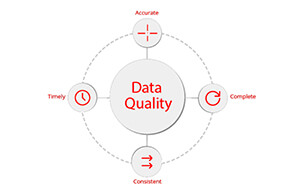
CRM data quality is the accuracy, completeness, consistency, and freshness of the contact, account, and pipeline records your revenue team relies on. High-quality CRM data makes segmentation, routing, personalisation, and reporting more reliable.
How do you measure CRM data quality?
You can measure CRM data quality with a few practical metrics: required-field completeness by lifecycle stage, duplicate rate, bounce/undeliverable rate, and the consistency of key picklist fields (job function, country/state, lifecycle stage). Then correlate those metrics with conversion KPIs like reply rate, connect rate, lead-to-meeting conversion, and stage-to-stage opportunity conversion.
What causes CRM data decay?
CRM data decay happens because the real world changes. People switch jobs, companies re-org, emails get disabled, phone numbers change, and territories shift. Over time, even a clean CRM becomes stale unless you run a refresh cadence.
How often should you dedupe a CRM?
Most teams should dedupe on a recurring rhythm—weekly for high-volume inbound and SDR orgs, and at least monthly for lower-volume teams. The key is consistency: a lightweight, repeatable dedupe workflow prevents duplicates from quietly compounding into routing issues and reporting noise.

Stay updated with our latest publications.
Discover Issues
See how we can help you grow in the online space!
Advertise With Us
We can help promote your business.
Find Out More