Corporate Office Design and Its Impact on Productivity and Engagement
f you’re calling a return-to-office (RTO), at least have enough chairs and desks.
Business Insider in December reported an alarming trend among many RTO directives: not enough work areas. Major companies like Amazon and AT&T are making such calls amidst a shortage of office chairs and desks. Because of this, many are postponing their RTO calls for some or all employees until they find a solution.
RTO is already facing backlash as it is, and returning to an ill-equipped office is adding fuel to the fire. Ensuring employee well-being is the responsibility of a business leader, as there can be no business without a solid team. Take this opportunity to reevaluate your corporate office space and think about what must change based on today’s office design trends.
Open Plan Is Failing
Collaboration was the buzzword that fueled the open-plan design revolution in the 20th century. The lack of partitions or walls fosters teamwork and makes bringing deliverables a breeze. Rearranging the layout was also easier, as there are fewer or no walls to tear down.
Then COVID happened. The open design isn’t as viable now.
For the record, doubts about the open office’s effectiveness have been around as early as before the pandemic. In 2017, the BBC reported that 70% of offices in the U.S. adopted an open office design. However, it also cited research that stated that it decreased employee productivity by 15% and increased the risk of illness by twofold.
As for promises of promoting morale and better exchange of ideas, that’s unlikely to occur if workers are getting distracted all the time. Add a shift of employee preference to private workspaces and quiet zones, and things aren’t looking up for open offices.
Because of this, the history of corporate office design comes full circle with the return of the cubicle. However, interior design experts cite that it isn’t the same as the cubicle of past decades. For starters, they have lower partitions to still keep a collaborative workspace and ergonomic workstations and smart storage solutions to improve work efficiency.
Whether to keep the open plan or return to the cubicle, your choice will affect the furniture that’ll go into the office. Hot desks may have to give way to smaller bench desks and chairs with ergonomic support to match. You can look for the right ergonomic furnishings in online stores like www.roseoffice.com.au and have them delivered.
More Color at Work
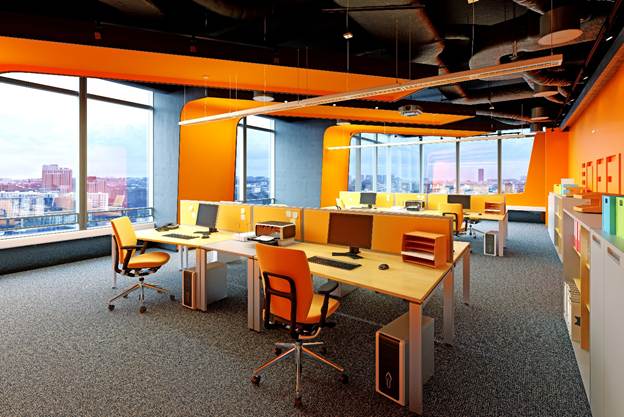
Effective business leaders know how to motivate their team. One way is by adding a splash of color to the workplace. Imagine shades of calming blue for the work area, warm orange for social spaces like the pantry, and relaxing green for accommodating guests.
The foundation for these interpretations is grounded in color psychology, essentially the study of how people react to colors. Although further research is still necessary, studies over the years have suggested that colors induce various effects on people.
A Wall Street Journal article in April 2025 outlined three ways companies interior design experts believe can harness color in corporate office design.
- Color drenching: The office design uses a single color (or various shades of one color). Experts believe that this approach can help make people more relaxed or improve their reading comprehension, depending on the color.
- Color coding: This method involves choosing a color based on the function the room or part of the office serves. For example, orange and yellow are ideal hues for common areas where employees socialize during breaktime.
- Contrasting: Businesses that want to remind employees who’s in charge harness darker hues and tones, especially for the executive areas. However, experts warn that taking it too far risks eroding employee trust.
It’s important to know that the effects of color on employees’ psyche doesn’t last forever. Also, some people may interpret certain colors differently from what’s established.
Install Windows (Not the Software)
Engineers used to believe that light fixtures were more effective than natural light (e.g., the sun). Some of their arguments include the ability to provide light all day long and the ability to change the light’s color, which natural light can’t do.
Then, around the 1980s, scientists discovered that the lack of natural light was seen as a potential cause of “sick building syndrome (SBS).” This is a term for health issues caused by being inside a building for a long time, which then subside after leaving. Experts point to varying brightness in artificial light that forces the pupils to dilate and contract incessantly.
Even without SBS interfering, studies have shown that the lack of natural light can affect an employee’s productivity. With the light sources only being from the lamps and electronics (known as blue light), the worker’s circadian rhythm gets thrown off. Business leaders who aren’t strangers to all-nighters know that lack of sleep tends to make one distracted.
Windows are a non-negotiable part of the office environment. If your office space is fully enclosed, have enough to let natural light in; if it has windows, take full advantage of them in the office design. Let your employees look at something else other than their screens after long hours to reduce eye strain.
Adding natural elements like plant boxes can contribute to employee well-being. They go well with living walls that highlight the office environment.
Design a Modern Workspace
The office of old is less likely to fit the needs of employees and the company as a whole. If your business has been in remote work mode for a long time, as its leader, consider adopting current office design trends to suit the needs of today’s environment. You’d be surprised at how much your team’s productivity and the overall employee experience will improve.

Stay updated with our latest publications.
Discover Issues
See how we can help you grow in the online space!
Advertise With Us
We can help promote your business.
Find Out More