Astronaut Trainer Reveals the Simple Rule That Helps People Stay Calm Under Extreme Pressure
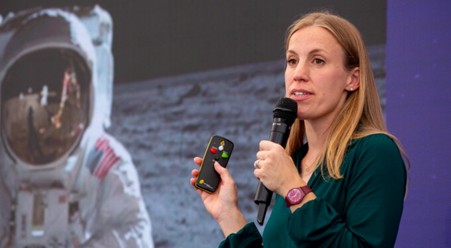
This exclusive interview with Susan Charlesworth was conducted by Tabish Ali of the Motivational Speakers Agency.
Pressure is usually treated as something to survive. Susan Charlesworth sees it differently: as something people can be trained to handle with clarity, discipline and calm.
A psychology and neuroscience expert, astronaut trainer and human performance specialist, Susan has spent more than 15 years working with the European Space Agency, training astronauts, flight directors and ground teams in the behaviours that matter when the stakes are at their highest. Her work has taken her from mission-control settings to Antarctic research stations, helping people build the communication, decision-making and resilience needed in extreme environments.
That experience gives her a rare view of leadership. In Susan’s world, leadership is not about status or job titles. It is about behaviour under pressure: who stays calm, who keeps the team together, who communicates clearly, and who can take the next right step when the full picture is missing.
In this exclusive interview with Mental Health Speakers Agency, Susan discusses what pressure does to human performance, why informal leaders often emerge in extreme environments, and how lessons from astronauts and Antarctic crews can help people build resilience, adaptability and better decision-making here on Earth.
Question 1. In high-pressure environments such as spaceflight, what happens to human performance when the margin for error disappears?
Susan Charlesworth: “Pressure can really make us focus. It’s like the brain has blinkers on and it draws attention to exactly what’s going on.
“When I train this with astronauts in the space sector, we’re talking about situations where they might come under very high pressure. That will cause them to focus but then fall back on their training. They get an awful lot of technical training and the non-technical training that I provide.
“The pressure causes them to focus and fall back on their training.
“For example, I talk quite a lot about one of the astronauts, Luca Parmitano. He was on a spacewalk when his helmet started filling up with water while he was outside the space station.
“You’d think normal people like you and me might panic, but for him that pressure caused him to focus, fall back on the training, and just take the next step. Eventually, he got back to the airlock in time.
“That was because of all the training that he’d received and the ability to focus and keep calm as well. I think that’s really important.”
Question 2. From astronauts to Antarctic crews, what separates effective leadership from simply having authority in extreme environments?
Susan Charlesworth: “I think that leadership is a behaviour rather than a title.
“If I can give another example, I also taught not just the astronauts but people who used to go to Antarctica for a year. A crew of 14 would live and work in Antarctica.
“They’d have to get on very well with each other because it’s an incredibly extreme environment in terms of the cold. They wouldn’t actually go out very much. They always used to think it was a great adventure, but they were mostly confined to the station for their own safety.
“What we found is, yes, there was always a designated leader who had a lot of experience and qualifications for the job, but quite often an informal leader would emerge because of their behaviour rather than their title.
“One in particular really stands out. He was the chef at the Antarctic base for quite a few years, not every year in a row, otherwise he would never leave Antarctica, but he came back, I think, about four or five times eventually.
“He really emerged as this informal leader. He had a lot of experience of being there. He knew what tensions might arise. He knew how to keep the team cohesion. And he also was a great chef, which is really important when you are isolated in Antarctica for a year.
“It was the behaviours that he showed that identified to me the traits and characteristics of a leader rather than just being told, oh, you’re the leader.
“It also showed that anyone can become a leader. You don’t have to have the title and the corner office to show those behaviours.”
Question 3. When a situation is uncertain and the full picture is missing, how do you train people to make clear decisions?
Susan Charlesworth: “If things are uncertain, particularly in extreme environments, I’ve just talked about spaceflight and spacewalks, and I’ve talked about living and working in Antarctica for a year as well.
“When you have a problem, for me it’s taking the next right step.
“You may not necessarily have the right answer. You certainly don’t have the perfect answer or necessarily have the big picture.
“If I talk again about the example of Luca Parmitano, stranded outside the space station, water filling his helmet, he didn’t know what was going on.
“Originally, they thought it was a different cause. They thought it was his drink bag that was leaking, and it turned out it was his spacesuit.
“As I said, he didn’t know what was going on, but he just took the next right step. For him, it was communicating down to ground and telling them that there was a problem. They actually helped him with this problem as well.
“Then the next thing was: right, okay, what can he do? Keep calm, trace his steps back to the airlock, to safety.
“It was literally, in his case, taking the next right step rather than focusing and worrying about what was going on and what the big picture was.
“I think it’s simplifying it. It’s breaking down the steps, not trying to be perfect, just trying to have a good answer because if you try and come up with the perfect solution, you’re quite often paralysed and can’t then make decisions.
“Iterate, try, learn, move forward, learn from your mistakes, and keep going.”

Stay updated with our latest publications.
Discover Issues
See how we can help you grow in the online space!
Advertise With Us
We can help promote your business.
Find Out More