7 Mechanical Aptitude Assessment Tools for Industrial Hiring in 2026
A new maintenance technician can talk through a gearbox repair in an interview and still stall when a pulley diagram asks which way the load moves. Résumés and interviews show what someone has done. They rarely show how well that person reasons about force, motion, and machines they have not seen before.
That gap matters because manufacturers invest heavily after the hire. A 2026 Manufacturing Institute survey estimated that new U.S. manufacturing employees receive about 47.6 hours of in-house and external training on average. A mechanical aptitude test helps you find the people who will absorb that training fastest, and the tools below differ more than their sales pages suggest.
What does a mechanical aptitude test measure?
A mechanical aptitude test asks candidates to reason about physical situations: which gear turns faster, where a beam balances, how a pulley changes the force needed. It measures the ability to understand and learn mechanical work, not experience on a specific machine.
That makes it different from two other kinds of evidence. A technical knowledge test checks what someone already knows, such as hydraulics or print reading. A work sample asks them to do a real task, like measuring a part or explaining a fault from a diagram.
For entry-level operator and assembler roles, aptitude usually matters most. For maintenance and skilled trades, most plants pair aptitude with a knowledge test.
How we chose these tools
Every tool on this list publishes a named mechanical aptitude, reasoning, or comprehension test for hiring. We checked each test’s coverage, length, and any published pricing on the vendor’s own pages in October 2026.
We left out platforms that only offer general cognitive tests. The list compares what each test covers and who it suits. It does not rank tools on validity claims, which you should check in each vendor’s technical documentation.
The 7 mechanical aptitude assessment tools
1. E Skill
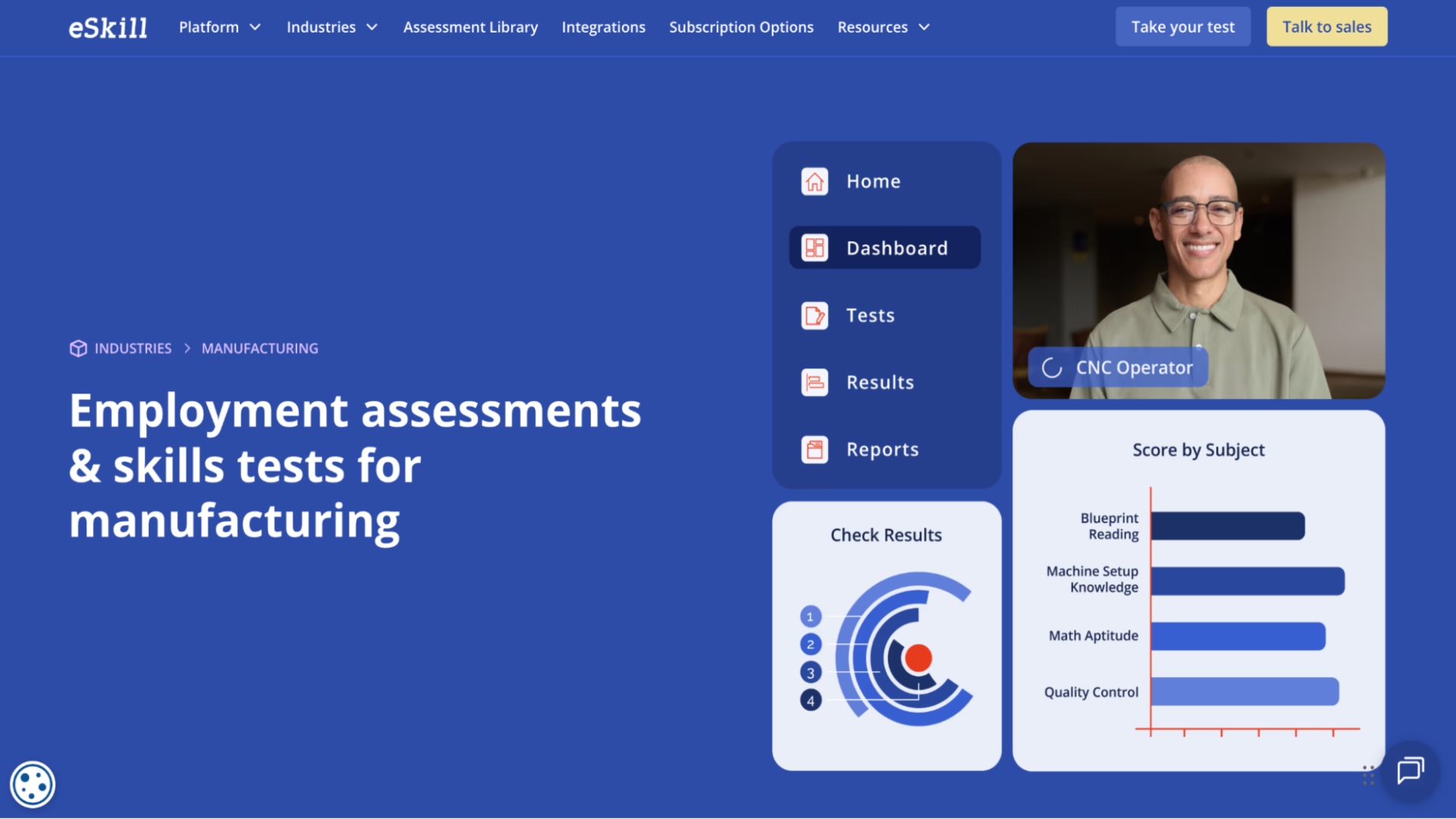
E Skill groups its manufacturing screening around mechanical aptitude, English and math comprehension, and attention to detail. Its mechanical aptitude test covers spatial reasoning, force and motion, tool recognition, and troubleshooting, while the comprehension side targets blueprint and graph reading plus units, dimensions, and numerical sequences. Hiring teams can mix questions across test types, request custom simulations, and upload their own job-specific questions.
Best for: Plants that want mechanical aptitude, industrial math, and error checking in one custom assessment for operators, assemblers, and maintenance hires.
Check before buying: Pricing is not listed on the manufacturing page, so request a quote and a sample candidate report.
2. Criteria
Criteria’s Mechanical Reasoning Assessment (CMRA) is a 30-question, 15-minute test that measures how readily a candidate can learn to operate, maintain, install, and repair equipment. It is written at roughly a sixth-grade reading level, and reports show a raw score plus a percentile. For a longer measure, Criteria also offers the 60-question, 30-minute Wiesen Test of Mechanical Aptitude (WTMA), which has a Spanish-language version.
Best for: Teams hiring machine operators, mechanics, and field service technicians who want a short, mobile-friendly screen.
Check before buying: The WTMA is not available in Asia-Pacific, so confirm regional access before standardizing on it.
3. Ramsay Corporation
Ramsay’s Mechanical Aptitude test (SKU 110) has 36 multiple-choice items covering home settings, production and maintenance work, school science and physics, and hand and power tools. Alternate and Spanish forms are available, and the 2026 catalog lists it at $29 per test on orders of 20 or more. Ramsay also publishes trade knowledge tests, such as the 60-item Mechanical Entry test, for roles that need skills on day one.
Best for: Maintenance and skilled trades hiring where an aptitude score and a craft knowledge test should come from one catalog.
Check before buying: Ramsay requires every test, paper or online, to run in a live proctored environment, so plan staff time for supervision.
4. SHL
SHL’s Verify Mechanical Comprehension test measures understanding of basic mechanical principles as they apply to devices such as pulleys, gears, and levers. SHL positions it for production, manufacturing, and engineering recruitment, including screening school leavers for apprenticeship schemes. Its catalog lists more than a dozen language versions, including Spanish, French, German, Polish, and Simplified Chinese.
Best for: Multinational manufacturers running apprenticeship or graduate intakes across several countries.
Check before buying: The catalog page does not list test length or pricing, so ask for both, along with norm groups for your regions.
5. TestGorilla
TestGorilla’s Mechanical Reasoning test takes 10 minutes and covers basic physical and mechanical concepts, including force and motion, speed, and pulleys, gears, and wheels. TestGorilla itself advises against relying on this test alone and suggests pairing it with other tests in the same assessment. TestGorilla lists machine operators, HVAC technicians, electricians, and welders among the roles it suits.
Best for: Smaller teams that want a quick mechanical screen inside a broader self-serve assessment.
Check before buying: A 10-minute test gives limited coverage, so decide whether it is enough evidence for safety-critical roles.
6. Mercer | Mettl
Mercer | Mettl’s mechanical reasoning assessment is modeled on the Bennett Mechanical Comprehension Test and covers center of gravity, gears, hydraulics, levers, pulleys, and belts. The test can be customized, and Mettl separately offers a mechanical engineering test for candidates with up to a year of experience in fields such as automotive and maintenance and repair.
Best for: Employers that want hydraulics and belt-drive concepts in the mechanical screen, or need a test they can tailor.
Check before buying: The test page lists English questions at a basic difficulty level, so confirm other languages and levels for your workforce.
7. Testlify
Testlify’s Mechanical Reasoning test runs about 10 minutes and assesses core mechanical and physics principles, how mechanisms operate, and the ability to handle objects. Testlify also markets a wider set of pre-employment assessments for manufacturing, so the mechanical test can sit beside role-specific skills tests.
Best for: Teams that want a short mechanical screen alongside role-specific skills tests.
Check before buying: The public test page gives limited detail, so ask for documentation on what the test measures and how to read scores.
How do you match the test to the industrial role?
The right test depends on what the job demands on day one versus what your plant will teach. The matrix below is a starting point to adapt to your equipment and tasks.
| Role | What the job demands at entry | Test type to use | Add this evidence |
| Machine or equipment operator | Read operating sheets and adjust settings within limits | Mechanical aptitude plus basic industrial math | A structured discussion of a line scenario |
| Assembler | Follow a build sequence and spot mismatches | Attention to detail plus reading comprehension | A supervised check of a part against a drawing |
| Maintenance technician | Diagnose faults on plant equipment | Mechanical aptitude plus a trade knowledge test | An explanation of a fault from a diagram |
| Quality inspector | Compare finished parts with specifications | Attention to detail plus measurement | Measuring sample parts with your plant’s gauges |
| Field service technician | Install and repair equipment on site | Mechanical aptitude | A supervised bench repair task |
Not every role needs blueprint reading or advanced math. Testing skills the job does not use can screen out people who would have done well. If assessments are new to your hiring process, roll them out the way you would pilot new tools anywhere in the business: start with one role, set clear success measures, and expand only once the results hold up.
How should you use the scores?
Treat a mechanical aptitude score as one piece of evidence, never the whole decision. A written test does not prove someone can run a machine safely, and it does not replace required licenses or certifications.
For U.S. employers, the EEOC’s December 3, 2007 fact sheet on employment tests says a test must be job-related and its results appropriate for the employer’s purpose. Keep a short record of why each test fits the role. The U.S. Office of Personnel Management also cautions that work samples may not suit activities you plan to train after hiring.
When you pilot a new test, have a person review results alongside interviews and work samples rather than setting an automatic cutoff. Track how quickly new hires reach supervised sign-off, and compare that with their scores before you scale.
The takeaway
The best mechanical aptitude test is the one that matches the role’s day-one demands. Short reasoning tests suit high-volume operator hiring, while maintenance roles usually need aptitude plus a knowledge test. Whichever tool you choose, ask for a sample report, technical documentation, and an accommodation process before you sign.
Frequently asked questions
What is the best mechanical aptitude test for machine operators?
A short reasoning test such as Criteria’s CMRA or a 10-minute mechanical reasoning test fits most operator screening, paired with a basic math check.
How long does a mechanical aptitude test take?
Among the tests here that publish a time limit, most run 10 to 30 minutes, from TestGorilla’s 10-minute test to Criteria’s 30-minute WTMA.
Is mechanical aptitude the same as mechanical knowledge?
No. Aptitude measures the ability to reason about and learn mechanical work, while knowledge tests check what a candidate has already learned.
Can a mechanical aptitude test replace a practical skills check?
No. For roles that need demonstrated skill at entry, add a supervised, risk-assessed work sample.
Are mechanical aptitude tests available in Spanish?
Yes. Criteria’s WTMA, Ramsay’s Mechanical Aptitude test, and SHL’s Verify Mechanical Comprehension test all have Spanish versions.

Stay updated with our latest publications.
Discover Issues
See how we can help you grow in the online space!
Advertise With Us
We can help promote your business.
Find Out More