
Recycling as a Business: Why the Industry Is Growing While Companies Keep Going Bankrupt
Despite the steady growth of the recycling industry and the global push for a “green” agenda, many new recycling businesses shut down within their first few years. The reasons include miscalculations, underestimating investment needs, and complex regulations. In the context of Europe’s transition to a circular economy, only those companies that are ready to invest in technology and build long-term processes survive.
Author – Aivars Sveida, founder and CEO of ZALAIS CIKLS and GREEN PLASTICS, waste recycling expert.
The Development of the Recycling Industry: From the Early 2000s to Today
The recycling business emerged as a distinct industry about 20 years ago. At that time, the “green” agenda was already gaining traction globally, but a comprehensive approach to recycling did not yet exist. Sorting was still done manually, automation was virtually non-existent, and 90% of recyclable materials were simply sent to China, which was experiencing an industrial boom at the time.
However, about ten years ago, the European Union restricted the export of raw materials to third countries in order to ensure that recyclable materials were processed within the region. This provided companies with a strong incentive to develop the industry, and within just a few years, they managed to develop automated equipment for sorting and recycling waste.
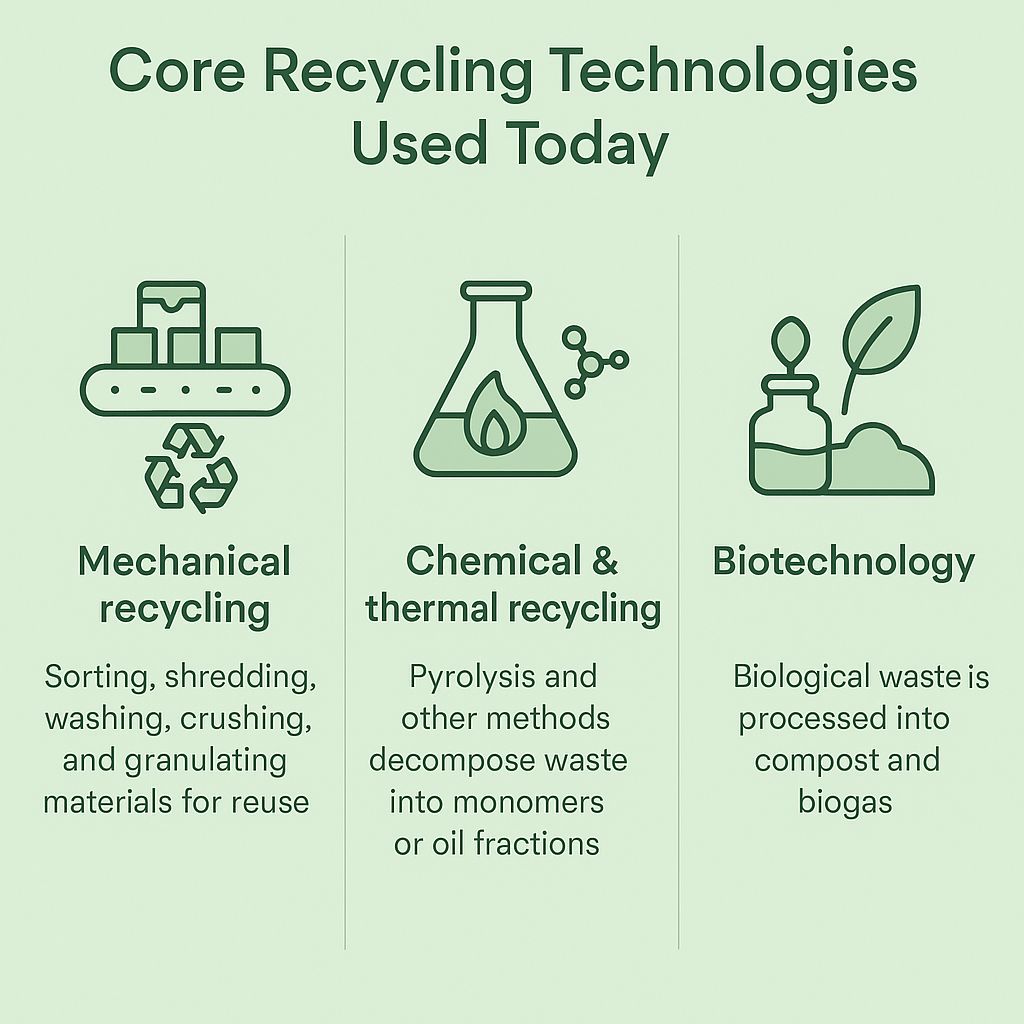
Today, the recycling industry employs technologies such as:
- Mechanical recycling: This includes sorting, shredding, washing, crushing, and granulating plastics, paper, non-ferrous metals, and other materials for reuse or the production of new products.
- Chemical and thermal recycling: Methods like pyrolysis and other technologies decompose waste into monomers or oil fractions, which can then be further used in the chemical industry.
- Biotechnology: Biological waste (food, plant material) is processed into compost and biogas using aerobic and anaerobic facilities.
Most European countries now have strict waste management regulations that require companies to actively participate in both sorting and recycling. This not only supports the global green agenda but also improves resource efficiency and reduces the land area required for landfills, and their environmental impact. As a result, developing a business in the recycling sector is one of the most promising opportunities in Europe.
Common Mistakes Made by New Market Participants
In my experience, the main mistake made by newcomers is an insufficient understanding of how this sector really operates. Many believe that client companies give away recyclable materials for free, and therefore they do not properly account for the initial costs when acquiring materials. This leads to major errors at the business planning stage and often results in bankruptcy within the first few years of a recycling company’s operation.
Every material has a price — including corporate waste. Therefore, budgets must include the cost of purchasing recyclable materials and estimate how much can be collected monthly, quarterly, and annually. It is also important to consider that recycled material, such as plastic, is cheaper than primary raw material, meaning profit from its sale will be lower.
Other common mistakes made by newcomers include:
- Underestimating production investments: To generate significant income in recycling, investment in modern equipment, automation, and employee training is necessary. Without this, there is a risk of falling behind competitors.
- Ignoring legislation: The industry has strict established environmental and sanitary standards. Non-compliance can result in significant fines or even the suspension of operations.
- Weak supplier and customer relationships: Efficient collection of recyclables and rapid delivery of processed materials to clients are key factors in the company’s market demand.
- Lack of diversification: It is possible to start with a single focus, such as waste collection or one type of material. However, for stability, the business must diversify — for example, by also offering recycling or logistics services in tandem with this.

Current Trends in Recycling
The primary trend in the sector is the move toward a circular economy, where one company’s waste is recycled and used as a resource by another, and primary raw materials are designed to remain in circulation for as long as possible. As early as 2018, the European Parliament passed legislation on the circular economy, aiming to recycle 70% of packaging by 2030. The industry is steadily progressing toward this target.
Other notable trends include:
- Use of artificial intelligence: AI helps process large datasets to improve sorting and recycling processes. AI systems are also used in business process management and logistics.
- Biodegradation as a new recycling method: Special microorganisms or fungi are used to recycle materials, making processes more environmentally friendly and less energy-intensive.
- Increased processing of complex materials: While plastics have traditionally made up the bulk of recyclable materials, research is expanding into the eco-friendly recycling of more complex materials, such as electronics.
- Modular production lines: As the variety of recyclables expands, there is a need for flexible production lines that can be adapted for any type of waste. This can be achieved through modular design.
The Future Outlook for the Recycling Industry
The world is moving toward globalization, and this applies to the recycling industry as well. Currently, the most successful companies are those with a significant market share, capable of purchasing advanced production equipment and applying the latest technologies. Twenty years ago, it was possible to collect small batches of waste, sort, and recycle it in small spaces — even in a garage. Today, this is no longer profitable. Achieving good returns requires significant initial investment.
Attention should also be paid to the tightening of bureaucratic requirements and regulations. Previously, simply purchasing equipment and starting operations was sufficient for a business, but today at least a year must be planned for environmental authorities to review projects for regulatory compliance.
Consequently, the market is likely to retain companies that are willing to invest in equipment, allocate sufficient time for detailed business planning, and fully comply with mandatory government inspections.
Conclusion
Although the recycling sector is currently one of the most promising in Europe, careful planning and attention to detail are essential for success. Major pitfalls include hidden costs for raw material procurement, technology implementation, and employee training. Businesses must also be prepared for extended regulatory inspections.
However, companies that overcome these challenges have strong prospects, as the world moves toward a circular economy. In the future, there will be a growing need for companies to collect, recycle, and sell reusable materials.

Stay updated with our latest publications.
Discover Issues
See how we can help you grow in the online space!
Advertise With Us
We can help promote your business.
Find Out More