How Blockchain Is Changing Compliance and Transparency in Finance
How Blockchain Is Changing Compliance and Transparency in Finance
Blockchain is changing how compliance and transparency work in finance by making financial transactions more secure, unchangeable, and shared across many users.
This technology, called distributed ledger technology (DLT), provides strong security that greatly improves trust and accuracy in financial systems. It helps fix common problems with traditional oversight and lack of visibility by giving everyone access to a single, reliable record of activities that can’t be changed or faked.
This shared record makes compliance simpler and supports transparency everywhere. If you want to learn what this means for areas like accounting, check out the benefits of implementing blockchain tech with accounting for a closer look.
What Does Blockchain Technology in Finance Mean?
Blockchain in finance means using a network of computers to manage and store financial transactions together, instead of relying on one central database. Each transaction is saved in a “block” of data.
Once a block is added, no one can modify or delete it. All the computers (nodes) on the network have the same record and keep it up to date together. This system replaces closed-off, hard-to-audit records with open, connected networks where everyone can see the same data.
The main advantage is that no person or organisation has to put all their trust in someone else. Instead, the trust comes from cryptographic rules and the way the network agrees on the details of each transaction. This shift is a big deal for finance, where safety and checking information are really important.
Blockchain can be used for lots of things such as international payments, trade, and managing assets-always providing a safer and clearer way to record and check any financial event.
Main Features of Blockchain for Compliance and Transparency
- Immutability: Once something is recorded, it can’t be changed. This creates a permanent audit trail, which is valuable for following rules and proving records are accurate.
- Decentralisation: No single point can change the data or be attacked easily. Instead, information is stored and checked by many people, so everyone has the same up-to-date data.
- Cryptography: Each transaction is protected with complex codes, and every block is connected to the next. This keeps the data safe and proof of who did what and when is clear. Smart contracts-small programs on the blockchain-can also automate compliance checks so they’re always applied correctly.
- Shared Ledger: Everyone with permission has access to the same information. This removes confusion and improves overall transparency.
How Is Blockchain Different from Regular Financial Systems?
Traditional finance relies on centralised controls-banks and clearing houses each keep their own records and act as trusted authorities. This makes systems slow, open to attacks, and hard to check for errors since only certain parties can see the information.
Changing or hiding transactions is possible, and sharing information across organisations is slow and complex.
Blockchain removes the need for a central authority. All data is held and updated across many computers simultaneously. This makes transactions quicker and removes many middlemen. Once data is recorded, it can’t be changed-which helps prevent fraud and simplifies auditing. The system is real-time and shared by all, making it much easier (and faster) to detect problems or confirm events.
How Blockchain Helps with Financial Compliance
Blockchain technology directly addresses common challenges in financial compliance, like matching up records, preventing fraud, and providing reliable audit trails. With blockchain, compliance becomes less of a slow, manual process and more about automatic, constant checks, reducing costs and errors.
Automated Compliance with Smart Contracts
Smart contracts are programs stored on the blockchain that carry out rules automatically. For example, a smart contract might only release money when all needed approvals are given, or flag a transaction if it’s too large. This avoids mistakes, cuts down on paperwork, and proves compliance actions happened without manual proof.
For example, if a trade doesn’t pass know-your-customer (KYC) rules, the contract can stop the transaction right away without human intervention.
Real-Time Auditing
Blockchain allows real-time auditing because every transaction is recorded instantly and can’t be changed. Auditors and regulators can check events as they happen, no longer needing to spend days or weeks collecting and verifying information. This makes audits much faster, more accurate, and supports constant monitoring for rule-breaking or odd activity.
Improving KYC and AML Processes
Know Your Customer (KYC) and anti-money laundering (AML) checks require banks to verify customers and monitor transactions for illegal activity. Blockchain can let people store their ID and share it easily and securely with multiple banks, avoiding repeated checks and improving data security.
For AML, the system’s transparency makes it simple to trace money trails and spot unusual patterns. If privacy is a concern, private blockchains let only authorised users view the sensitive data.
Making Regulatory Reporting Easier
| Traditional Method | With Blockchain |
| Collect data from many sources and match them up | Access single, shared ledger with up-to-date information |
| Manual, slow, sometimes inconsistent reporting | Automated reporting from real-time, accurate data |
| Risk of missing or incorrect information | Consistent, reliable reports every time |
Smart contracts can even build rules directly into transactions, so actions always follow regulations automatically.
How Blockchain Makes Finance More Transparent
Better transparency means everyone can see and check transactions, raising trust and making it harder to hide wrongdoing. Blockchain’s design makes information easy to access (when allowed), accurate, and impossible to change after the fact.
Records That Can’t Be Changed
Transactions, once added to the blockchain, are permanent. This prevents backdating, erasing, or falsifying information. Anyone checking a record knows it’s authentic and unchanged since it was created, making fraud more difficult and ensuring all actions leave a clear trace.
Public vs. Private Blockchains
- Public Blockchains: Open to everyone. Anyone can see transactions (but usually not personal details). Useful where total openness is important.
- Private Blockchains: Access is limited to chosen users. This keeps sensitive financial information private but still allows trusted members to see and verify transactions. Many banks use private blockchains to balance openness and confidentiality.
How DLT Reduces Fraud
DLT (Distributed Ledger Technology) means everyone on the network has the same, up-to-date record. If someone tries to make a fake entry, the other participants will notice the difference immediately and won’t accept the change.
Also, changing one transaction would require changing every following record, which is almost impossible. With all activity tracked in real time, it becomes much easier to see, stop, or prevent fraud.
Main Benefits of Blockchain for Compliance and Transparency
- Lower Costs and Faster Operations: Getting rid of middlemen, reducing manual checks, and having automated processes cuts work times and costs. Less need for reconciliation and fewer disputes saves money and hours of work.
- Building Trust: Shared, unchangeable, and transparent records let customers, institutions, and regulators trust the information they see.
- Quick, Reliable Reporting: Financial data is always ready and accurate, so institutions can easily meet reporting requirements and regulators can get a clear picture whenever they need it.
Main Challenges and Risks for Blockchain in Compliance and Transparency
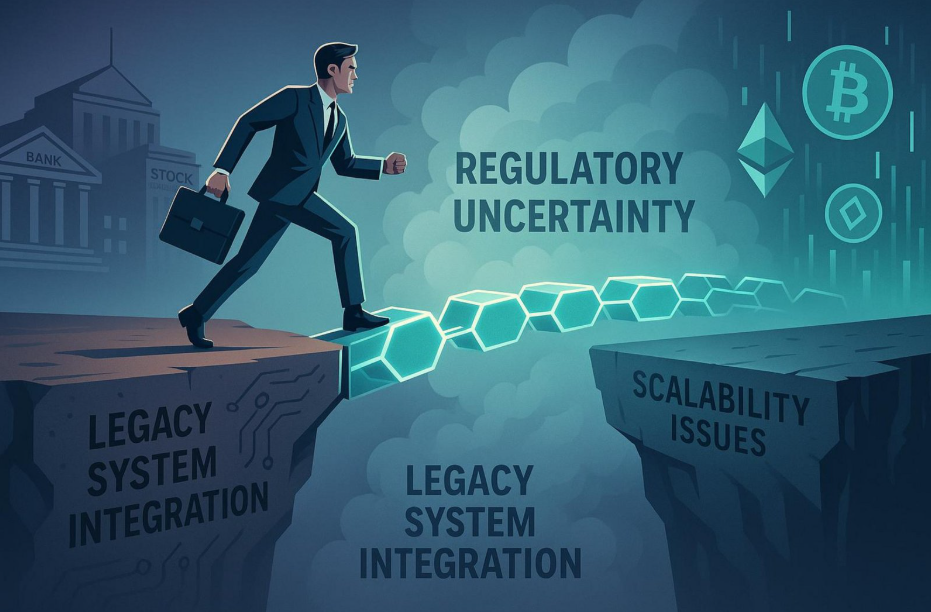
While blockchain brings improvements, banks and other financial firms face challenges when trying to use it fully. Problems include technical obstacles, unclear regulations, and the difficulty of fitting blockchain into existing systems.
Technical and Security Issues
- Scalability: Public blockchains may slow down with lots of transactions. Private blockchains are faster but lose some decentralization.
- Compatibility: Getting different blockchains to talk to each other, and with older banking systems, isn’t simple.
- Application Security: While the blockchain itself is safe, the surrounding software might have weaknesses. Mistakes in smart contract code or weak password protection can cause problems.
- Key Management: Losing the digital keys that control access means losing funds forever, so secure storage is a must.
Regulatory and Legal Challenges
- Lack of Clear Regulation: Rules differ between countries and are made for old, centralised systems. This makes it hard to know which laws and requirements apply.
- Uncertainty: Some rules may require new interpretations or legal updates, especially for things like self-executing smart contracts or handling data across borders.
- Legal Recognition: Not every country or court recognises blockchain data or smart contracts as legally binding.
Problems Integrating and Scaling Up
- Legacy Systems: Old banking infrastructure isn’t built to work with blockchain. Updating everything is expensive and takes time.
- Adoption: Blockchain only works best when many parties use it, but organisations are slow to join unless others do first. Building support takes effort and proof that the investment is worth it.
How Top Financial Institutions Use Blockchain for Compliance
Despite the issues, leading banks and financial services are already trying out and using blockchain. They often work in partnerships, set up special teams, or join industry groups to build shared solutions.
Banks and Financial Services Case Studies
- JPMorgan Chase: Their Onyx network uses a private blockchain for payments, allowing faster internal settlements with an unchangeable ledger that helps with compliance and audits.
- Marco Polo: Run by banks like BNP Paribas and Commerzbank, this platform uses blockchain to speed up trade finance and keep a shared record of trades for simpler and safer compliance checks.
- HSBC: Has tested using blockchain for KYC to speed up customer checks and improve data security, reducing repeated work between branches and banks.
Regulators and Blockchain Collaboration
- Monetary Authority of Singapore (MAS): Started Project Ubin with banks to explore blockchain for payments and settlements, focusing on how to keep everything compliant with local regulations.
- Central Bank Digital Currencies (CBDCs): Many central banks are building or testing digital currencies based on blockchain, often including built-in rules to support compliance automatically.
By working together, regulators learn what blockchain can do and help shape future laws and guidelines that work for both safety and innovation.
The Future of Compliance and Transparency with Blockchain in Finance
Blockchain is moving towards being a regular part of how finance works. The security, openness, and automation it brings are strong reasons why more institutions are interested, even though there are still obstacles to overcome.
Trends in Blockchain Laws and Use
Gradually, more countries are creating clear laws and standards for blockchain, digital assets, and related technology. As these rules settle, financial organisations will be more willing to use blockchain on a larger scale.
Standards that let different systems talk to each other will also help, letting blockchain work side-by-side with classic finance.
Other Technologies Combined with Blockchain
- AI and Machine Learning: Can process large amounts of blockchain data to spot problems or suspicious activity automatically.
- IoT (Internet of Things): Can feed real-world events into the blockchain, making it more useful for things like insurance or supply chains.
- Quantum Computing: Long-term risk and opportunity for data protection and more secure blockchain systems.
- Zero-Knowledge Proofs: Let transactions be checked for honesty without revealing personal or sensitive data-solving privacy worries on public blockchains.
The Next Steps for Finance
By the late 2020s, blockchain could be common in everyday finance. International payments will likely be quicker and cheaper. Digital assets-physical things tracked as tokens-will create new investment opportunities and clear records of ownership. Central bank digital currencies may be in use in many countries.
Compliance will shift from lengthy processes to instant, automatic checks built right into the transaction. Hybrid systems, mixing classic methods with blockchain networks, are the most likely path for finance going forward.

Stay updated with our latest publications.
Discover Issues
See how we can help you grow in the online space!
Advertise With Us
We can help promote your business.
Find Out More